There are strong differences between the divers and cave divers sump and how they relate to the cave environment, how to set up equipment and what they are trying to achieve. sump diver is more than just a cave diver and more than just dry cavers. sump diver combines dry caving and cave diving techniques in a unique way to achieve a specific goal - to negotiate water-filled passages to explore dry cave on the other side. While enjoying cave divers swimming around in water-filled passages as an end in itself, that divers wet sump is actually an obstacle to be negotiated, rather than the ultimate prize. For dry caver sumps are impenetrable and are the end of the journey, sump diver on the other hand is almost unstoppable.
It's not all beer and skittles, however, more often than not actually getting the sump in a dry cave requires not only dragging its sorry ass a few kilometers, but also carries the mountains dive gear to boot. For those of us who enjoy driving to the dive site, the tightness of tanks and taking a leisurely stroll down the carpeted stairs to the water, it can seem a bit, well ... enthusiastic.
Undoubtedly, wearing various pieces of dive gear and tanks on the far reaches of the cave in order to dive was pretty intense. However, the rewards are titillating, and it's worth wearing down your body and pushing themselves to reach them. In my opinion, this is what a real cave exploration is all about, plasters the necessary equipment and negotiating some serious cave. When I finally combined dry caving and cave diving it's like that moment when the peanut butter and chocolate collided ... "Two great tastes that taste great together" ... Reese's peanut butter cups anyone?
My first sump diving experience was courtesy of Forrest Wilson, who invited me along on a trip to a snail shell. Snail Shell Cave is the longest continuously in the Middle Tennessee region of the pool and has more than 9 miles of surveyed passages. Our second trip to push upstream sump felt like a big effort, especially with diving equipment in tow. We spent over 10 hours underground and covered more than 14,000 ft. At the end of the boys (Mike Young, Adam (skip) Kendrick) provided further 400ft line. However, I once saw a map of the entire system, it was clear that our stay in the cave is not even scratching the surface. The sheer size and potential of these 'dry' caves dwarfs most of their colleagues drowned.
Because my first sump diving experience was a little wet around the ears. I wore a 3mm suit, generally unsuitable for the conditions, which meant that I froze. I pull in tanks that are way too big for the sump only 70ft in length. Even sidemount armor is hindsight, way too bulky and had too many extra bits and pieces. GUE'm sure people would stop if it comes face to face with the sump divers. Gear selection is based on the nature of the cave and whether it can carry up to the edge of the water. Keepings things light and effectively is of primary importance, small tanks, wings, light harness and flippers are often not just what the doctor ordered
.Sometimes you have to be creative and invent your own equipment. Once I had to rig without armor mounted on the spot to investigate a small leak in the river upstream flight, the Jenolan caves. I had no hope of fitting into a hole in the standard sidemount armor, so that 'zero' profile I threw some bits of bungee and hose retainers together. 'Flight' armor, with some minor changes since it became my rig of choice when the sump diving. It gives me a low profile in the water, but it allows me to walk with a leash and 7L tank for a few thousand feet. Sometimes you just have to get creative.
Despite being clueless and ill-prepared, travel Snail Shell was an incredible experience. The cave is like a subterranean river, where they negotiate the passage of a large creek swimming, wading and walking through the big pools of water. By the time you wade through the breakdown of pilots and across waterfalls. And in between getting your ass kicked in a cave, you are treated to some spectacular scenery and incredible formations. These tend to distract from serious conditions, although temporarily. When we finally reached the end line and a second sump, the guys I was encouraged to grab the reel and reel from a few meters, to experience the passing line. By the time I was on the verge of hypothermic and playing the researcher was the last thing on my mind, and I refused, and concentrated on getting myself warm. I am, however, get my first taste of sump diving and I loved it!
So, from my first sump diving experience let us forward into an adventure across the other side of the world, all the way in Australia, in fact, where I play a researcher. Buchan area one of the largest karst features in the State of Victoria, the southernmost state of mainland Australia. It is a farming area, green grass, rolling hills, cows and all that. Beneath this landscape area and honeycomb caves. Cave Reserve in particular is absolutely full of caves with more than 90 recorded. pit narrowly escaped the 80-stone them and is now protected by Parks Victoria, which is amazing considering the importance of this area.
In 2006, Victorian Limestone Caving Team (VLCT) discovered 330ft perennial streamway the pit Reserve, which is called the Elk River because of the prominent "horn" formation found. This is an incredible discovery, and for the first time cavers got a glimpse into the underground river that has long been mooted to exist in this area, but they all escaped. Research soon stopped, however, as the way forward was blocked in both up and downstream side of sumps.
In 2008, my friend James (Jim) Arundale probed an underwater extensions on each end of the Elk River. He found difficult to push through, but eventually negotiated a tight and nasty sump and was rewarded with another 400ft of streamway pass before another sump stopped his progress. Finally, in August 2009, with Peter Freeman Coordination Victorian Speleological Association (VSA) effort, Jim and I am ready to fight second downstream sump. I became a partner in crime to what is surely the biggest robbery century!
We joked about finding kilometers from the passage before descending, but to actually find a 5000ft pass, basically everything in one go is just mind-blowing. I mean really, who actually believes that much of a cave passage these days, especially in little old Buchan? Buchan Caves, and interestingly, tend to be quite a bit. maximum pitch is only 130 meters long, and most cave seems to end all too soon. While hopeful, we did not expect to hit the jackpot. However, we achieved, and what we found exceeded all our expectations.
Elk River, seems to be a major drain for the area, long lost and much theorized about the master cave system. The cave is of great importance in Victoria and most importantly from 1907-1910, when Frank Moon discovered the Fairy Cave and Royal (Show Buchan Cave system). discovery of a completely re-written the book on hydrology and geological structure in this area. drainage does not go in the direction most expected, the only significant visible revival in this area. In fact, it goes the opposite direction! Furthermore, it is easily the deepest pit in Victoria, now 350ft down, and has the potential to drop even further. What is amazing considering that none of the caves in the Buchan area go deeper than 200 ft on top of that, it has the potential to become the longest continuous flow passage in Victoria. These awards mean a cave system is now referred to as Murrindal Rupe Eastern Master Cave (MPEMC). official title does not quite roll off the tongue, so we still fondly refer to it as poor.
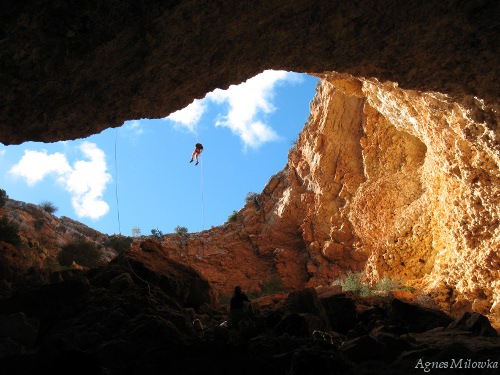
down to the actual water level is the journey itself, and if you add that number of bags filled with heavy diving gear, you are facing severe hit. Login streamway over Baby Berger cave and abseil involves little laddering and a lot of record before you go into the water. One in particular is indexing, which can most politely be described as an absolute embarrassment. Finally, there are several roof to get to sniff sump itself. The roof is going to sniff almost filled to the top, but not quite. little space between the water and the ceiling means that you can negotiate for floating on his back, nose to the ceiling, 'sniffing' ceiling. Then, finally, you come first and the hardest of the sumps.
In all aspects of the cave is just breathtaking. We followed the stream, and dived through the crankcase sump catches ... 'Wow', and 'oooh my' and 'oh no this is just incredible' ... between a few minor expletives family. As the cave took place in front of us, it's hard to believe what we were seeing. Cave formations are amazing, with areas of highly concentrated formations such as flowstone, stalactites, stalagmites, pools and rimstone helictites.
the nature of the cave so the changes from low to high bedding planes rift passages, the large chambers and narrow cracks. Then there are a series of waterfalls and climbs, a couple who needed some upbeat and interesting stunts to free climb up on our first trip over. Then, do not forget the deep, slippery mud, and overlaid with water, which makes walking painful and tiring. Each step feels like you're falling into the abyss of snow, but in this case, no skis that can come to the rescue. All in all there are 9 sumps in the cave. While the beautiful cobalt blue on their way in, they get dirty quickly. On the way out they tend to resemble a mud bath and you have to feel and grope their way out, because they often can not even see his hand on the line. All this certainly makes for a very sporty and unforgettable journey.
We spent up to 18 hours underground on a massive journey that combined measurements, photographs and research at the end of the cave. We often got back just before the collapse of the cottages the crack of dawn, but it was not long until they were all in bed together celebrating success. We describe our adventures between woofing down meal ... followed closely by a bottle of red. Only then we collapsed into bed.
It was a phenomenal experience to be part of the research that changed the face of Buchan area forever. The best part - fun is not over yet. There is more diving to be done on both sides of Elk River and many more to find and explore caves in dry areas. For now I have more questions than answers, so we are now faced with the recruitment of scientists that could help us solve some of the mystery. For now, the only diver trip, but we hope to find an alternate entrance that will allow for dry cavers to access the system.
During the four trips we have had terrific support in the dry part of the cave. Without these people, working trip would be nearly impossible. So, a big thank you goes to Peter Freeman, Neil Wilson, Ian 'chalky' Thomas, Miles and Daryl Pierce and Ted Matthews, Ken Smith and Michael Collins, who has bestowed all grabbed the package and it humped up sump.


0Awesome Comments!